
Carrito
0
If you’re choosing between a 1:14 and a 1:24 RC car, start with the space where you’ll actually drive it. A small car can make a tight indoor course more fun. A larger replica gives you more room to see details like the wheels, bodywork, and paint. Either can be a good buy if its controls, turning circle, and ground clearance suit your space.
What do 1:14 and 1:24 scale mean on an RC car?
The number describes the model’s size relative to the full-size vehicle it represents. A 1:14 replica is roughly one fourteenth of the original vehicle’s length. A 1:24 replica is roughly one twenty-fourth. For the same real car, the 1:14 version would be about 71% longer than the 1:24 version.
For example, a real car that measures 14 feet long would be about 12 inches at 1:14 or 7 inches at 1:24. Use these figures for a rough comparison, then check the listing for actual measurements. A replica of a long sports car and a replica of a short hatchback can differ in length even when both carry the same scale label.
When a 1:24 RC car makes sense
Pick a compact car if your driving space is a section of smooth floor and you plan to set up short laps around cones. A smaller body leaves more room between obstacles and makes it easier to store the car and controller. It also gives you more options for laying out a course that can be cleared away after use.
Check the steering and throttle specifications before ordering. A car that moves abruptly when you press the controller can be harder to thread through a narrow course than a car with gradual control. Measure the available route, including the turn at each end. An open straightaway only helps if there is enough room to turn and come back.
The HST LUX licensed 1:24 RC car listing gives you a compact example to compare. Check the selected version and the listed power requirements, since the car and controller may use different batteries.
When a 1:14 RC car makes sense
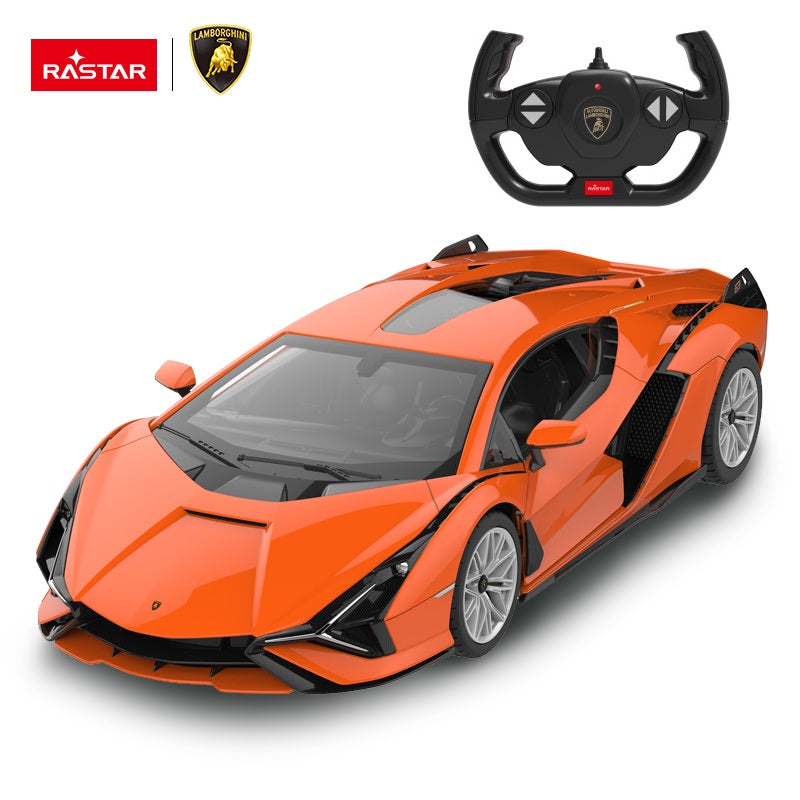
A larger replica is easier to see across a wide, open area. It can also be a good choice if you want to display a favorite car between drives. For example, the Rastar Lamborghini Sian in 1:14 scale represents a different size class from a compact 1:24 model. Compare their dimensions and features directly to see how much extra space the larger car needs.
If you plan to drive outside, use a suitable flat, clear area away from traffic and check the manufacturer’s surface guidance. Small stones, pavement joints, and uneven edges can catch low bodywork. Ground clearance and tire design matter more on rough surfaces than the size printed on the box. A larger road car can still sit close to the ground.
Compare the controls and setup before buying
- Steering: Look for details about whether the steering angle is adjustable from the controller. If the listing specifies full left and right commands, leave extra space around tight turns.
- Throttle: Check whether the car can creep forward or only has fixed speed commands. Lower-speed control makes a short course easier to drive.
- Power: Confirm what powers the vehicle and controller, which batteries come with the package, and what charging accessories are included.
- Surface: Check what the manufacturer recommends for the particular model. Smooth flooring, thick carpet, and uneven pavement place different demands on the tires and chassis.
- Age guidance: Use the manufacturer’s recommendation for the exact product, especially when buying for a child.
A quick way to test your driving space
- Measure the clear floor area between furniture legs or the edges of your intended course.
- Mark out the length and width of the car with paper. Move that outline through the narrowest part of your route to see where the body might clip an obstacle.
- Leave a clear turnaround at each end. Ask for the turning circle if the listing does not include it and space is tight.
- Check for thresholds and transitions. Pick a level, smooth route if you’re shopping for a low-profile road car.
When comparing models in the RC vehicles collection, start with body size and recommended surface, then review the controls and package contents. That order makes it easier to find a car you’ll have space to drive regularly.
Frequently asked questions
Is 1:14 bigger than 1:24?
Yes, for replicas of the same full-size vehicle. The 1:14 model will be about 71% longer. Compare actual dimensions when the models represent different cars.
Is a 1:14 RC car always faster?
Speed depends on the model’s motor, gearing, power source, and electronics. Check the specifications for each car.
Which scale is better for a small indoor course?
A 1:24 car is a good starting point because it uses less floor space. Check the turning circle and throttle behavior before laying out a tight route.
Can a 1:24 RC car drive on carpet?
Check the model’s recommended surfaces. Carpet pile can rub against low bodywork or make small wheels harder to turn. Smooth hard flooring is a better starting point for many small road cars.
Do RC cars include batteries?
Package contents vary. Check the listing for the car’s power source, the controller’s battery requirements, and any charger or cable included.