
Carrito
0
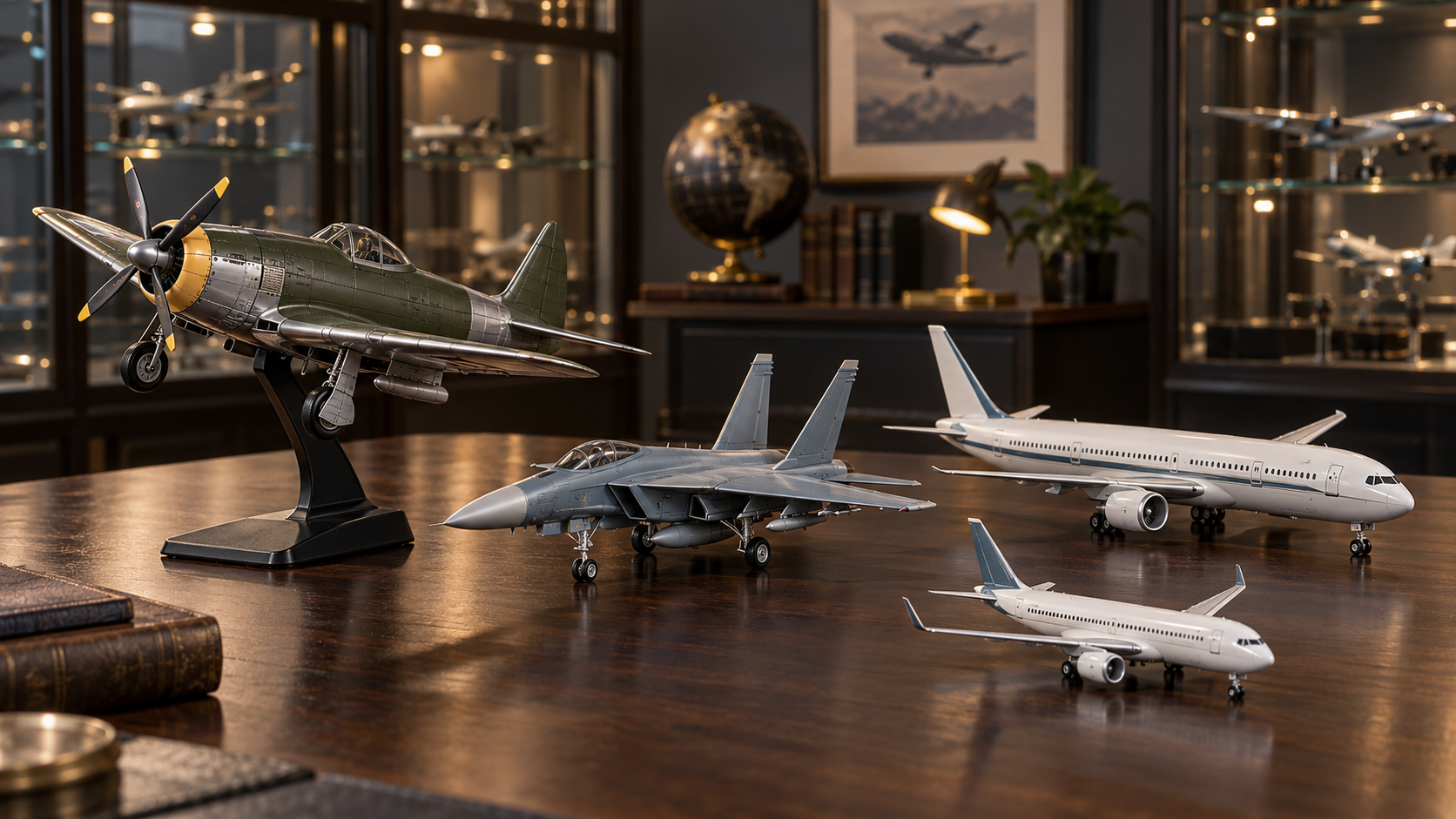
Diecast airplane scales can look confusing when you first start collecting. A box marked 1:72 may contain a detailed fighter jet, while a commercial airliner is more likely to appear in 1:200 or 1:400. The second number changes, but what does it actually mean for the model on your shelf?
Scale affects much more than size. It influences the level of visible detail, price, weight, display space and the types of aircraft available. Choosing the right scale early can also help your collection look more organized. This guide explains the most common diecast airplane scales and helps you decide which one fits your interests.
What Does Diecast Airplane Scale Mean?
A scale is the relationship between the model and the real aircraft. On a 1:72 model, one unit of length on the miniature represents 72 of the same units on the full-size airplane. One inch on the model represents 72 inches on the real aircraft.
The most important rule is simple: the larger the second number, the smaller the model. A 1:72 aircraft is larger than the same aircraft produced in 1:200, while a 1:400 version is smaller again.
To estimate model size, divide the real aircraft’s dimensions by the scale number. For example, a real airplane measuring 144 feet long would be 2 feet long in 1:72 scale because 144 divided by 72 equals 2. In 1:200 scale, that aircraft would measure about 8.6 inches.
Remember that aircraft type matters too. A 1:200 Boeing 747 can still be wider and longer than a 1:72 fighter because the real airliner is much larger.
Why Are Different Aircraft Sold in Different Scales?
Manufacturers choose scales that balance detail with practical size. Military fighters are relatively compact, so they can be reproduced in larger scales such as 1:32, 1:48 or 1:72. Commercial airliners have long fuselages and wide wingspans, making smaller scales such as 1:200 and 1:400 more convenient.
This is why collectors often develop separate scale preferences for military and civilian aviation. There is no universal best scale. The right option depends on the aircraft you enjoy and the space you have available.
1:32 Scale: Maximum Presence and Detail
The 1:32 scale is one of the largest common options for military aircraft. It gives manufacturers room to reproduce cockpit instruments, landing gear, panel lines, weapons and other small features. A 1:32 fighter can become the centerpiece of a room, especially when displayed with its wings and landing gear fully extended.
The tradeoff is space. Large fighters may require deep shelves, and bombers can become difficult to accommodate. These models may also be heavier and more expensive than smaller versions.
Best for: Serious military aviation collectors, centerpiece displays and people who prioritize detail over space.
1:48 Scale: A Strong Balance for Military Aircraft
The 1:48 scale offers much of the visual impact of 1:32 without requiring quite as much room. Fighters, helicopters and World War II aircraft are large enough for visible cockpit and surface details, yet manageable in a cabinet or on a dedicated shelf.
It is a popular choice for collectors who want each aircraft to stand out individually. However, building a large fleet in 1:48 still requires planning, especially if you collect aircraft with wide wingspans.
Best for: Detailed military collections, medium-sized displays and collectors who want a balance of presence and practicality.
1:72 Scale: The Popular Choice for Military Collections
The 1:72 scale is one of the most versatile choices for military aircraft. It is large enough to show paint schemes, squadron markings, weapons and landing gear, but compact enough for several models to share one shelf.
Another advantage is variety. Fighters, bombers, transport aircraft and helicopters are commonly produced in this scale. A fighter remains easy to display, while even a larger transport aircraft is more manageable than it would be in 1:48.
Collectors interested in historic and modern military aviation can compare a broad selection of 1:72 diecast airplanes, including fighters and transport aircraft from different eras.
Best for: Military aviation, fleet building, broad aircraft variety and balanced detail.
1:144 Scale: Compact but Still Recognizable
The 1:144 scale sits between the common military and commercial-airliner formats. It works well for large bombers, transport aircraft and passenger jets that would take up too much room in 1:72.
Models at this scale still show recognizable liveries and structural features, but the smallest cockpit and landing-gear details are less prominent. It can be an excellent choice for collectors who want several large aircraft in a modest display area.
Best for: Large military aircraft, compact airliner displays and collectors with limited shelf depth.
1:200 Scale: Detailed Commercial Airliners
The 1:200 scale is especially popular for commercial aircraft. Airliners are large enough for airline colors, registration markings, landing gear and engine details to be appreciated without dominating an entire room. Many models also include display stands, giving collectors the option of showing the aircraft in a clean, in-flight position.
A widebody airliner in 1:200 still needs a substantial shelf. Before buying, check both the model’s length and wingspan rather than relying on the scale alone. Narrow-body aircraft and regional jets are easier to group, while larger jets often work best as individual display pieces.
Browse 1:200 scale airplanes if you want commercial aircraft with a stronger physical presence and more visible detail.
Best for: Airline enthusiasts, detailed liveries, display stands and premium commercial-aircraft collections.
1:400 Scale: Best for Building an Airline Fleet
The 1:400 scale is much smaller, but that is exactly why many airline collectors prefer it. Several passenger jets can fit into the space required by one large 1:200 model. This makes it easier to collect different airlines, aircraft types or historical liveries without filling every shelf.
It is also a practical scale for airport dioramas. Terminals, maintenance equipment and multiple aircraft can be arranged in a believable scene. Fine details are naturally smaller, so careful handling is important, particularly around landing gear and antennas.
The 1:400 diecast airplane collection is a useful starting point for comparing airliners, cargo aircraft and airport display accessories.
Best for: Airline fleet building, airport dioramas, small spaces and collectors who value variety.
Quick Diecast Airplane Scale Comparison
| Scale | Typical aircraft | Display size | Main advantage |
|---|---|---|---|
| 1:32 | Fighters and military aircraft | Very large | Maximum visible detail |
| 1:48 | Fighters and helicopters | Large | Detail with better practicality |
| 1:72 | Military aircraft | Medium | Excellent range and balance |
| 1:144 | Airliners and large military aircraft | Small to medium | Compact size for larger subjects |
| 1:200 | Commercial airliners | Medium to large | Detailed airline display models |
| 1:400 | Commercial airliners | Small | Fleet building and airport scenes |
How to Choose the Right Airplane Scale
Start with the type of aircraft you want to collect. If military fighters and historic aircraft interest you most, 1:72 is often the easiest scale to build around. Choose 1:48 or 1:32 when you want fewer models with greater visual impact.
For commercial aviation, compare 1:200 and 1:400. Choose 1:200 if you want to appreciate individual aircraft, detailed liveries and display stands. Choose 1:400 if your goal is to build an airline fleet, recreate an airport or collect many liveries in limited space.
Measure your shelves before ordering. Wingspan is often the dimension that catches new collectors by surprise. Leave room between models so tails, wings and landing gear are not knocked together. Enclosed cabinets provide additional protection from dust and accidental contact.
Finally, check what comes with the model. Some include stands, removable landing gear or accessories, while others are designed only for ground display. Product descriptions should be reviewed individually because features can vary even within the same scale or manufacturer.
Can You Mix Different Airplane Scales?
You can mix scales, but grouping them thoughtfully creates a cleaner display. Keep aircraft of the same scale together when you want to compare their real-world sizes. If scales are mixed on one shelf, separate them by theme, era or aircraft type so the size differences feel intentional.
Final Thoughts
Understanding diecast airplane scales makes collecting much easier. A lower scale number produces a larger model, while a higher number creates a smaller, more space-efficient replica. The most useful choice depends on what you want to display.
For military aircraft, 1:72 provides an excellent balance of detail and variety. For commercial airliners, 1:200 offers greater presence, while 1:400 is ideal for fleets and airport scenes. Explore the full diecast model airplane collection, compare the available dimensions and choose a scale that fits both your aviation interests and your shelves.