
Cart
0
Diecast motorcycles let you collect the bikes you admire without needing garage space for the full-size machines. A small road bike can sit beside a model car, while a larger motocross replica can become the focus of a shelf. The right choice depends on what you want to see, how much room you have and whether the model will be displayed or handled.
Before buying, compare the exact motorcycle, scale, construction and included accessories. Two models with a similar photograph can have very different dimensions and features.
What are diecast motorcycles made from?
The term diecast usually refers to metal components made in a mold. A finished motorcycle model may also contain plastic parts, clear pieces, flexible tires and printed decoration. It does not mean every component is metal.
Construction varies by release. Small mirrors, handlebars and fairing details may be delicate even when the main model feels substantial. Read the specific listing rather than assuming a heavier bike is automatically more accurate or more durable.
Also distinguish a finished model from an assembly kit, a resin miniature or an RC motorcycle. A display replica does not become a working remote-control bike simply because the wheels turn.
Choosing a motorcycle model scale
Scale describes the relationship between the model and the real motorcycle. At 1:12, a dimension on the model is theoretically one-twelfth of the corresponding full-size dimension. A smaller denominator means a larger model of the same bike.
| Scale | Best starting point for | What to check |
|---|---|---|
| 1:6 | A substantial single-bike display | Shelf depth, height and stand footprint |
| 1:12 | A closer view of bike-specific details | Actual measurements and fragile accessories |
| 1:18 | A compact collection of several motorcycles | Detail level and included support |
| 1:64 | A miniature street or garage scene | Compatibility with cars, buildings and figures |
For a simple illustration, a real bike measuring 84 inches long would be about 7 inches at 1:12, 4.7 inches at 1:18 and 1.3 inches at 1:64. Those numbers are calculated examples, not measurements of every model. Handlebars, a stand and protective packaging add to the space you need.
If you already collect cars, matching the scale helps create a coherent scene. A 1:12 motorcycle placed beside a 1:64 car will look enormous even though both are small collectibles.
Choose a theme before choosing a brand
Road bikes and everyday favorites
A collection can start with a motorcycle you have owned, ridden or wanted to own. The appeal may be the shape of the tank, a familiar color or the engineering layout. Look for the correct model designation and year where these are important to you.
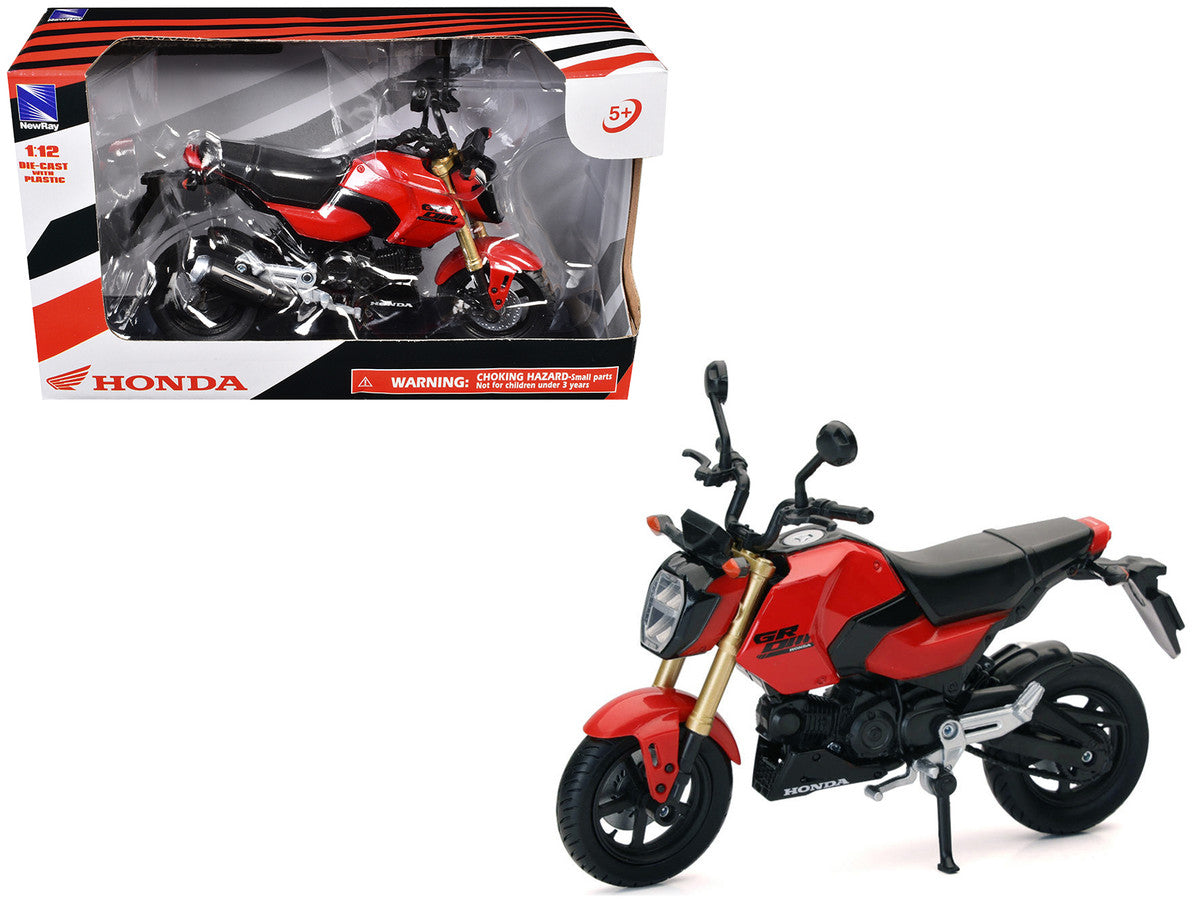
A compact road-bike example is the Honda GROM 1:12 model by New Ray. Use the individual listing to confirm its construction, features and current availability.
Cruisers and touring motorcycles
Touring bikes can introduce luggage, windscreens and a different silhouette from a stripped-back road bike. Consider how much of that detail remains visible in the intended display. A side view may show the bodywork well, while a slightly angled position can reveal the front wheel and cockpit.
Motocross and race replicas
For rider-specific releases, check the race number, team graphics and event or season description. Similar motorcycles can represent different liveries, and a color match alone does not establish the correct version.
Decide whether you want one favorite rider, a single manufacturer or a range of racing disciplines. A clear theme helps a growing shelf feel curated and reduces purchases that do not fit the collection.
Details worth checking in product photos
- Paint and graphics: look for a consistent finish and decoration that matches the stated version.
- Wheels and tires: check their appearance and whether rolling wheels are explicitly listed.
- Front end: inspect the fork, handlebars, headlight and windscreen where applicable.
- Engine and exhaust: assess how clearly the visible components are represented.
- Stand or base: confirm how the bike will remain upright and whether support is included.
- Moving features: verify steering, suspension or other functions individually. Do not infer them from scale alone.
Product photography can hide small compromises, so use several angles when available. If a feature matters and is not described, ask before ordering. A model with simpler construction can still be the better purchase if it represents the bike you want at a size that suits your space.
How to plan a motorcycle display
Measure the usable shelf depth and height before choosing a larger scale. Leave room around the handlebars and mirrors so neighboring models do not touch. A flat, stable surface and the intended stand or base help reduce accidental movement.
For a compact lineup, the Maisto Fresh Metals 1:18 motorcycle range provides a relevant scale to compare. Check the selected bike variant carefully because a range listing may show several different motorcycles.
Keep models away from a shelf edge and positions where sleeves, cables or cleaning tools can catch them. An enclosed case can reduce dust exposure, but check internal clearance and ventilation rather than selecting it only from external dimensions.
If you want a street scene, start with a consistent scale and add only a few supporting pieces. The diorama collection is a place to compare settings, but verify the scale and contents of each item. Buildings, figures and vehicles shown in a photograph are not necessarily all included.
Buying a model motorcycle as a gift
The most useful information is the recipient's preferred bike or riding style, followed by available display space. A larger model is not automatically the more thoughtful gift. A compact replica of a favorite motorcycle may have more meaning than an impressive model of an unrelated machine.
Check whether the recipient wants a finished display model or enjoys building kits. Read the age guidance on the exact product. Collector models may include small parts and should not be assumed suitable for young children because they resemble toys.
Keep packaging and product information if the recipient may want to store or move the model later. Present the purchase as a collectible to enjoy rather than promising future resale value.
Frequently asked questions
Is 1:12 bigger than 1:18?
Yes, for the same real motorcycle. A 1:12 model is larger than a 1:18 model. Compare listed dimensions when choosing between different bikes.
Do all diecast motorcycles have working suspension?
No. Moving features vary by model. Check the product description rather than assuming that a particular scale or brand includes suspension.
Are diecast motorcycles entirely metal?
Not necessarily. A finished model can combine diecast metal with plastic and other materials. The individual listing is the best place to confirm its construction.
Can a model motorcycle be used in a car diorama?
Yes, when its scale and proportions suit the scene. Match the motorcycle to the cars, figures and surroundings, and check the space needed for its stand.
What should a beginner buy first?
Start with one motorcycle you like in a scale that fits your shelf. Confirm the dimensions, support, construction and included features before building a larger themed collection.