
Carrito
0
A well-made diecast car can remain in excellent condition for years. However, improper storage can gradually fade its paint, mark the finish or damage small details.
Direct sunlight, dust, moisture, fingerprints and unsuitable packing materials can all affect a model. Damage can also occur when cars are placed too close together, stacked in weak boxes or repeatedly handled by their mirrors and opening parts.
Whether you have one display model or hundreds of boxed cars, the objective is the same: keep each model clean, dry, supported and protected from unnecessary contact.
This guide explains how to store diecast cars without damaging their paint, including loose displays, original packaging, mixed scales and long-term storage.
What Can Damage a Diecast Car in Storage?
Most storage damage develops gradually. A model may look fine when placed on a shelf but show fading, marks or corrosion months or years later.
Direct sunlight
Strong sunlight can fade paint, weaken printed graphics and discolor clear plastic components. Displaying a model near a bright window may also expose it to repeated temperature changes.
Keep models away from direct sunlight. Curtains, blinds and UV-filtering display materials can provide additional protection, but they do not make a sun-facing shelf completely risk-free.
Excessive heat
Attics, garages, vehicles and outdoor sheds can become extremely hot. High temperatures may affect adhesives, tires, plastic components and certain painted finishes.
A normal interior room with relatively stable temperatures is generally safer than an area that becomes hot during the day and significantly cooler at night.
Moisture and changing humidity
High humidity can encourage corrosion, while sudden changes may cause condensation inside a container or display case.
It is recommended that a relative humidity range of approximately 35% to 55% for stable metals stored as part of mixed collections. Maintaining a stable, moderate indoor environment is more practical than chasing an exact number. Review the metal-storage guidance.
Dust and dirt
Dust can retain moisture and may contain particles that scratch the finish when rubbed across the model.
An enclosed display or individual container reduces the need for frequent cleaning. Less cleaning also means fewer opportunities for accidental damage.
Fingerprints and skin oils
Handling a model with bare hands can transfer oils, salts and moisture to its surface. These marks may become more difficult to remove over time.
For particularly valuable or highly polished models, clean nitrile gloves can help prevent fingerprints. It is recommends avoiding direct contact with metal surfaces where possible.
Contact with other models or packing materials
Two cars touching inside a crowded container can rub against each other whenever the box is moved. Bubble wrap, rough paper, degrading foam and certain soft plastics may also leave marks or stick to painted surfaces.
Every model should have enough space and support to prevent movement without placing pressure on the paint.
Clean and Inspect Each Car Before Storage
Never place a damp or dirty model into a closed container.
Examine the car under good lighting. Look for loose parts, fingerprints, dust, damaged decals, paint bubbling or early signs of corrosion.
Remove loose dust with:
- A clean, very soft brush
- A manual air blower
- A clean microfiber cloth used with minimal pressure
Hold the model over a padded surface while cleaning it. Avoid directing strong compressed air at mirrors, antennas, decals and other delicate components.
Do not apply household cleaners, automotive polish, alcohol, solvents or abrasive products unless the model’s manufacturer specifically recommends them. A product that is safe for a full-size car may damage miniature paint, plastic windows or printed graphics.
For valuable models, take photographs before placing them into storage. This provides a condition record and makes future changes easier to identify.
For more general selection and maintenance advice, see this diecast car guide.
Handle Diecast Cars Without Marking the Finish
A significant amount of damage happens while a model is being moved rather than while it is sitting in storage.
Before handling a collectible:
- Wash and dry your hands or wear clean nitrile gloves.
- Remove jewelry that could scratch the surface.
- Prepare the storage container before picking up the car.
- Work over a clean towel or padded table.
- Keep food and drinks away from the area.
Lift the model from beneath its chassis or base. Do not pick it up by the roof, windshield frame, mirrors, spoiler, wheels or opening doors.
Use both hands for larger 1:18 or 1:24 models. These cars can be heavier than they appear, and their small exterior details are not designed to support their weight.
Children should handle sturdy play-oriented models separately from delicate collector pieces. Always check the product’s age guidance because some models contain small removable parts.
Choose the Right Storage Room
The storage location matters as much as the container.
A suitable room should be:
- Dry and free from condensation
- Away from direct sunlight
- Protected from major temperature changes
- Free from water leaks
- Relatively clean and dust-free
- Away from strong chemical fumes
- Easy to access without moving heavy objects
Avoid storing valuable models in an attic, damp basement, outdoor shed or uncontrolled garage. Keep containers away from exterior walls, heating vents, radiators and windows.
For a large collection, an inexpensive digital thermometer and humidity monitor can help identify seasonal changes. The objective is to maintain a reasonably stable environment and detect moisture problems early.
How to Store Loose Diecast Cars on Display
Loose models are easy to enjoy, but open shelving exposes them to dust, sunlight and accidental contact.
Safer display options include:
- Enclosed glass cabinets
- Acrylic display cases
- Individual clear covers
- Enclosed wall-mounted cases
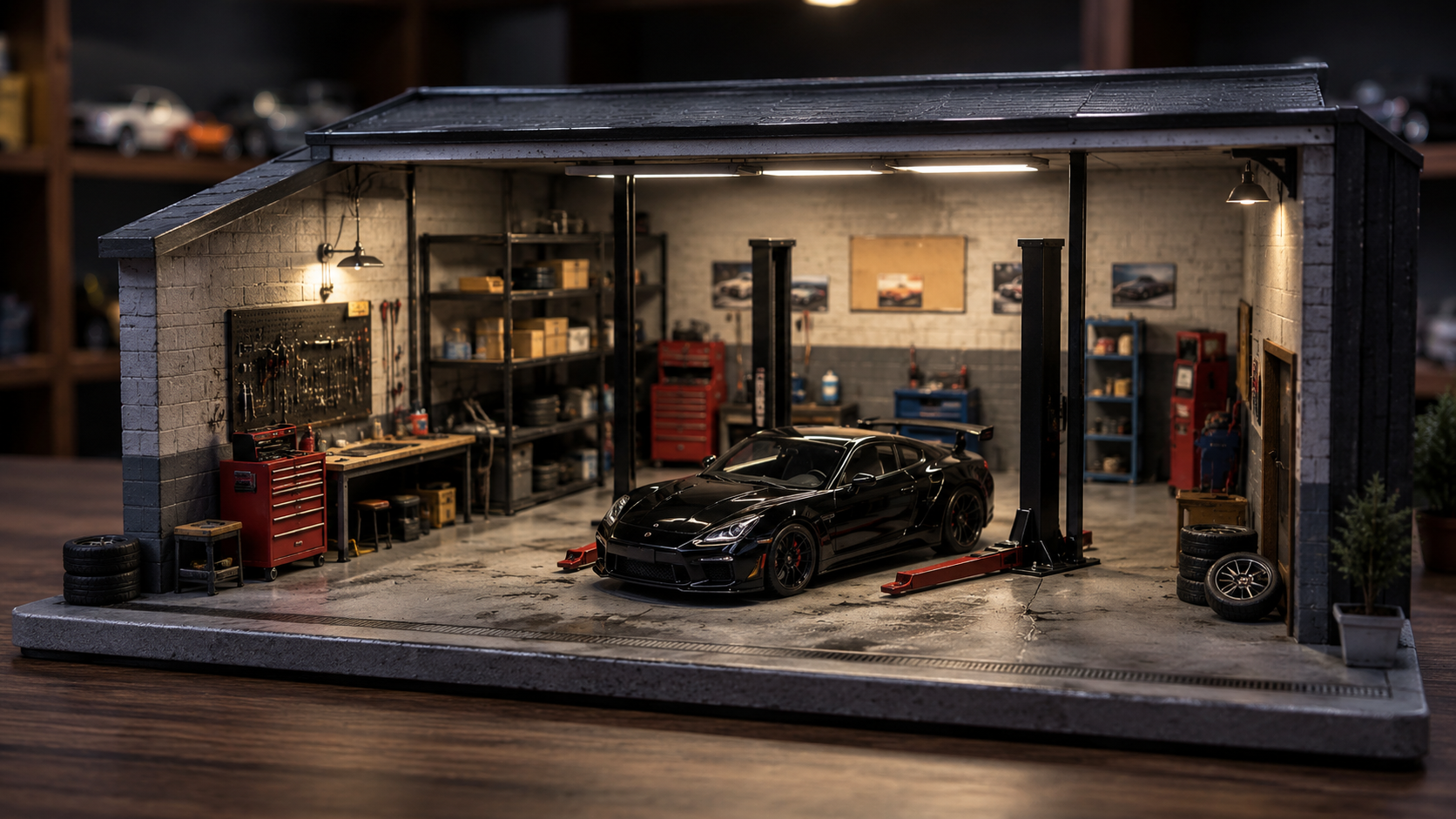
- Covered diorama displays
Place each model on a stable, level surface. Leave enough room between cars so their doors, mirrors and body panels cannot touch.
Avoid resting models directly on rough wood, painted shelves, adhesive surfaces or degrading foam. Clean acrylic bases, glass shelves and chemically stable liners are generally safer choices.
Displaying different scales
Each scale requires a slightly different approach:
- 1:64 cars: Compact cases with individual compartments make organization easier and prevent cars from rubbing together.
- 1:43 cars: Individual display covers or divided shelves provide visibility without requiring excessive room.
- 1:32 cars: Allow additional space for opening features and delicate exterior details.
- 1:24 cars: Use deeper shelves and check the total weight before filling a cabinet.
- 1:18 cars: Place them on strong, stable shelves. Their weight makes falls and shelf failure more damaging.
Collectors can browse scale-specific models through the 1:64, 1:43, 1:32, 1:24 and 1:18 collections.
How to Store Diecast Cars in Their Original Boxes
Keeping a model in its original packaging can preserve its presentation and may matter to collectors who value complete boxed examples.
However, the original box still needs protection.
Store boxed models:
- On a strong, level shelf
- Away from sunlight and moisture
- With the identifying label visible
- Without excessive weight on top
- With enough room to remove one box without dragging the others
- In an area protected from pests
Do not build tall or unstable stacks. Their weight can crush lower cartons, distort clear windows and place pressure on the model or its internal packaging.
Inspect the original insert before long-term storage. It should be clean, dry and correctly positioned. If an old foam insert is crumbling, sticky or leaving residue, do not allow it to remain in contact with the car.
Avoid taping or writing directly on the original box. If identification is necessary, place the boxed model inside a larger protective container and label that container instead.
Original packaging can reduce dust and handling, but it cannot protect a model from extreme heat, excessive moisture or flooding.
How to Prepare Diecast Cars for Long-Term Storage
Long-term storage requires more preparation than placing several cars in a large plastic bin.
Create a collection inventory
Record each model’s:
- Manufacturer
- Vehicle name
- Scale
- Color
- Product or edition number
- Purchase date
- Storage location
- Current condition
Add photographs of valuable or limited-edition models. A digital inventory reduces unnecessary handling because you can check what you own without opening every box.
Give every model its own protected space
Models should not move, touch or carry the weight of other cars.
Use individual containers, original fitted inserts or carefully arranged dividers. Chemically stable closed-cell polyethylene foam can provide support, but it should not press tightly against painted body panels.
Avoid placing bubble wrap directly against paint for an extended period. Its texture may leave impressions, and some plastic materials can degrade over time.
Support the model evenly
The car should rest naturally on its wheels or manufacturer-supplied base. Do not place pressure on mirrors, exhausts, spoilers or opening panels.
For heavier models, check periodically for tire deformation. If additional support is needed, use a stable model stand or cradle that distributes weight without contacting painted bodywork.
Prevent movement inside the container
The model should not roll or slide when the container is moved. Padding should support the base and wheels instead of pressing against the roof or sides.
The National Park Service recommends trays, supports and enclosures to reduce physical damage during storage and handling. Its museum collection storage guidance provides more information about protective storage.
Label the outside
Include the model’s name, scale and inventory number on the outer container. Adding a photograph to the label can make identification easier.
This prevents repeated unpacking and reduces the likelihood of returning a car to the wrong insert.
Inspect the collection regularly
Long-term storage should not mean forgotten storage.
Set an inspection schedule, such as every three to six months. Check for:
- Moisture or condensation
- Musty or chemical odors
- Paint becoming soft or sticky
- New fingerprints or marks
- Corrosion or powdery residue
- Yellowing plastic
- Cracking tires
- Degrading foam
- Pest activity
- Crushed packaging
If you notice corrosion, paint bubbling or an unfamiliar residue, separate the affected model from the collection. Avoid aggressive cleaning until the cause is understood.
Should You Use Silica Gel?
Silica gel can help moderate humidity inside an enclosure, but it is not a permanent solution that can be added and forgotten.
Only use it when:
- The container and model are completely dry
- The packet cannot touch the car
- You can monitor the enclosure’s humidity
- The silica gel can be checked and reconditioned
- The model’s materials do not require different conditions
An unmonitored desiccant eventually becomes ineffective. Excessively dry storage may also be unsuitable for certain rubber, plastic, paper and adhesive components.
For most home collections, choosing a stable interior room is more important than placing silica gel in every box.
Storing Models Made From Different Materials
A diecast model may contain metal, paint, plastic, rubber, resin, adhesive and printed decals. These materials may respond differently to the same environment.
Keep the following in mind:
- Resin components can be brittle and may break under pressure.
- Clear plastic windows scratch easily.
- Rubber tires may deform or react with unsuitable surfaces.
- Decals can lift when repeatedly handled or cleaned.
- Adhesives may weaken under excessive heat.
- Painted metal can be scratched by hard plastic packaging.
- Cardboard boxes can absorb moisture even when the model appears dry.
Do not assume every model can be packed in the same way. Check the manufacturer’s instructions and examine the materials before selecting a liner or container.
Recommended Storage Method by Collection Type
|
Collection type |
Recommended approach |
Main risks to avoid |
|
Loose display models |
Enclosed cabinet, acrylic cover or covered display |
Sunlight, dust, fingerprints and falls |
|
Models in original boxes |
Supported shelving in a dry interior room |
Crushing, moisture and damaged inserts |
|
Long-term archived models |
Individual labeled containers with stable support |
Movement, condensation and unsuitable packing |
|
Mixed-scale collections |
Separate shelves or containers according to size and weight |
Heavy models damaging smaller cars |
|
Family collections |
Separate play models from delicate collectibles |
Drops, small parts and repeated handling |
Common Diecast Storage Mistakes
Avoid these common mistakes:
- Displaying models in direct sunlight
- Storing valuable cars in an attic, garage or damp basement
- Placing several loose cars in one cardboard box
- Wrapping painted surfaces tightly in bubble wrap
- Allowing cars to touch inside a display case
- Stacking heavy models or boxes above lighter ones
- Cleaning models with household chemicals
- Applying full-size automotive wax without manufacturer approval
- Sealing a damp model inside an airtight container
- Leaving silica gel unmonitored for years
- Picking models up by their mirrors, doors or spoilers
- Storing models near fresh paint, strong adhesives or chemical fumes
- Assuming the original box makes environmental conditions irrelevant
Frequently Asked Questions
Is it better to store diecast cars in their original boxes?
Original packaging can protect a car from dust and reduce handling, provided it is clean, dry and not placing pressure on the model. Display cases are better for visibility, while original boxes may be preferable for long-term organization.
Can I wrap diecast cars in bubble wrap?
Avoid placing bubble wrap directly against painted surfaces for long-term storage. Use the original insert or a stable barrier and support system that prevents movement without pressing against the paint.
What humidity is best for diecast cars?
A stable, moderate indoor environment is best. Conservation guidance recommends approximately 35% to 55% relative humidity for stable metals kept in mixed collections. Avoid damp conditions, condensation and rapid fluctuations.
Does sunlight damage diecast paint?
Yes. Prolonged exposure can fade paint and printed graphics and may yellow certain clear plastic components. Keep displays away from direct sunlight even when using a cabinet.
Should I wear gloves when handling diecast cars?
Clean nitrile gloves can help prevent fingerprints and skin oils from reaching valuable models. Clean, dry hands may be sufficient for ordinary handling, but always hold the car by its base or chassis.
How often should diecast cars be cleaned?
Clean them only as often as necessary. An enclosed display reduces dust accumulation and therefore reduces the handling that can cause scratches.
Can a diorama protect a diecast car?
A diorama provides an organized and stable display setting, but an uncovered diorama will not stop dust, sunlight or humidity. For greater protection, place the diorama inside an enclosed cabinet or under a suitable clear cover.
Protect the Collection While Keeping It Enjoyable
The best storage system protects a collection without making it impossible to enjoy.
Keep models in a stable interior environment, handle them carefully and give every car enough space. Use enclosed displays for frequently viewed pieces and individually supported containers for long-term storage. Inspect the collection regularly so minor problems can be addressed before they become permanent.
For collectors who want to turn selected cars into realistic display scenes, explore the available dioramas and choose an option that matches the model’s scale.